Look in any dictionary and you’ll find the phrase ‘arigatō’ (ありがとう), or ‘arigatō gozaimasu’ (ありがとうございます). So, simple. Problem solved. It’s like saying ‘cat’ is ‘neko’ (猫), or ‘book’ is ‘hon’ (本): there is a clear and well-defined correspondence. Isn’t there?
Just off the coast of Takehara, there’s a small island in the Seto Inland Sea.
The island is called Okunoshima.
The 15-minute ferry ride from Tadanoumi Port is a beautiful journey, especially on a sunny day, when the inland Sea is at its beautiful, sparkling, beguiling best, with the islands hazy in the morning sun.
Stepping off the ferry, the island feels peaceful, and deeply relaxing.
I thought that baseball at high school in Japan was as much about manners and discipline as it was about the sport itself. But obviously, judging by what I saw on the train today, I was wrong.
There were four high school boys, all baseball players. I know that because they were all wearing their school’s baseball caps with their school uniforms. On a busy train just before seven o’clock at night, when the trains are full of people commuting from work, they were taking up not four seats, but six seats. What’s more, they were sitting in the priority seat section.
Now call me heartless, but I strongly feel that if they’re baseball players, they don’t need to be sitting in the priority seats. What’s more, all four of the boys were using smartphones. One of the rules about the priority seat section is that smartphones shouldn’t be used because they can affect pacemakers and other medical devices.
I would suggest that before such boys start playing baseball, they learn a few manners. Surely that should be the priority rather than throwing a few balls around, shouldn’t it?
This may be too much information, but I bought some toilet rolls today, a pack of twelve.
At least there doesn’t currently seem to be a general shortage of toliet paper, though, unlike at the beginning of the coronavirus epidemic, but even so, since when has toilet paper been so expensive? I don’t need to buy it that frequently because I live on my own, but the last time I bought it, it certainly wasn’t eight hundred yen for twelve rolls.
Is this something to do with the Iran war, or is it just general inflation? Actually, I suppose it could be either…
I finished work a little bit early today, so I had a walk to the supermarket. Well, it reminded me of nothing more than a children’s playground. There were at least three groups of elementary school-aged children running around like maniacs, and one of the groups even had a little toddler girl in tow. And the control by the parents? What control by the parents? In fact, I didn’t even see any parents!
I’d say that to all intents and purposes, as far as the children were concerned, It was just a big, wide open space, and therefore a space to play around in. And so what if there were people trying to do their shopping?
I’m glad that I’m normally at work at this time of the day.
I was on a train on the San’in Line the other day, and the train was quite full. Surprisingly full, in fact, for the San’in Line.
Anyway, a group of five people- parents and three children, two boys and one girl— came past looking for seats. One of the boys nudged the other, pointed at me, and said, ‘Hey, look.’ Of course, I could hear and I could understand. So I said to the boy, ‘Is there some problem?’ He said, ‘No, no problem.’ I told him it was rude to point, and that was it.
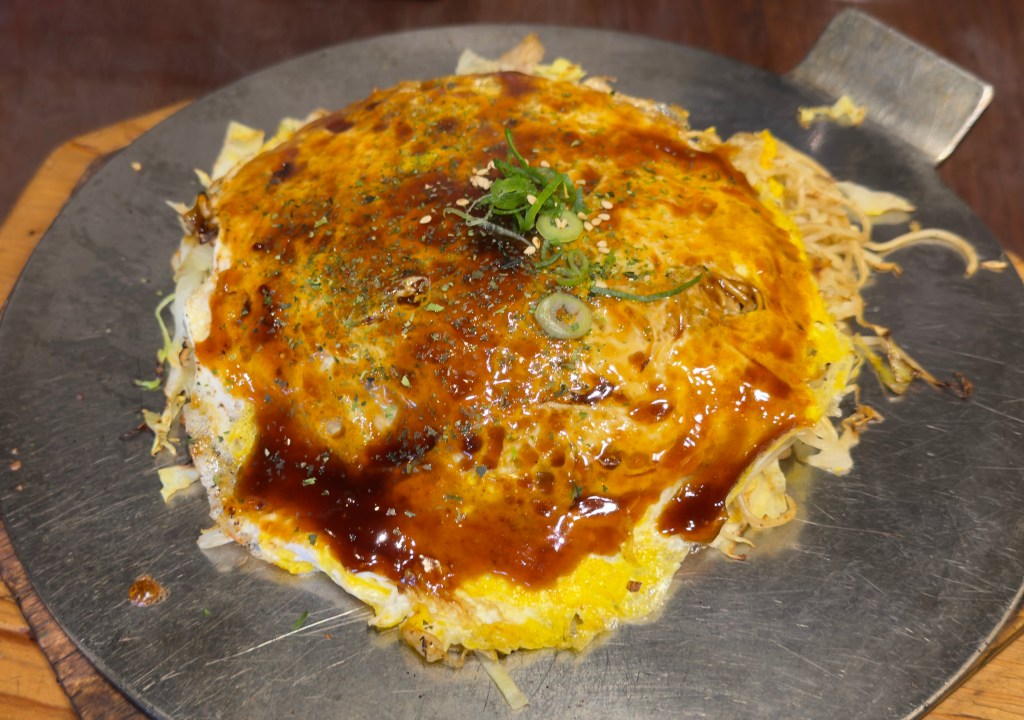
I went for okonomiyaki for lunch today, for the first time in several months. Now, of course, this being Hiroshima, okonomiyaki means Hiroshima okonomiyaki. (Hiroshima people can get quite irate if you say ‘Hiroshima-style okonomiyaki’, so I won’t, but that’s what it was.) It’s very different to Kansai okonomiyaki. This being Hiroshima, I wouldn’t dare say anything other than that I prefer the Hiroshima version to the Kansai version, but actually, that happens to be the truth.
Near my house, there’s a funeral parlour, and they were advertising the fact that you could get an estimate in advance as to how much your funeral, would cost.
On one hand, that’s a great idea.
But on the other hand, it seems rather gruesome, really, to be talking about how much your funeral would cost. And I’m assuming that either the person whose funeral is being discussed goes and takes part in the discussion, or that at least they are aware that the discussion is being had.
Either way, it doesn’t seem like a very pleasant thing to be talking about, does it?
I wrote earlier about a dentist called ‘Baumkuchen‘. So here’s a little more about baumkuchen in Hiroshima.
Baumkuchen is a traditional German cake made by layering thin coats of batter onto a rotating spit. When sliced, it resembles the rings of a tree—hence the name ‘tree cake’ (Baum=tree, Kuchen=cake).
Baumkuchen arrived in Japan- specifically, Hiroshima- thanks to Karl Juchheim, a German pastry chef.
During World War I, Juchheim was captured and held in Japan at the Bando POW Camp. After the war, in 1919, he showcased Baumkuchen at the Hiroshima Prefectural Products Exhibition. This was the first time Baumkuchen was introduced to Japan, and Hiroshima prides itself on being where it all started.
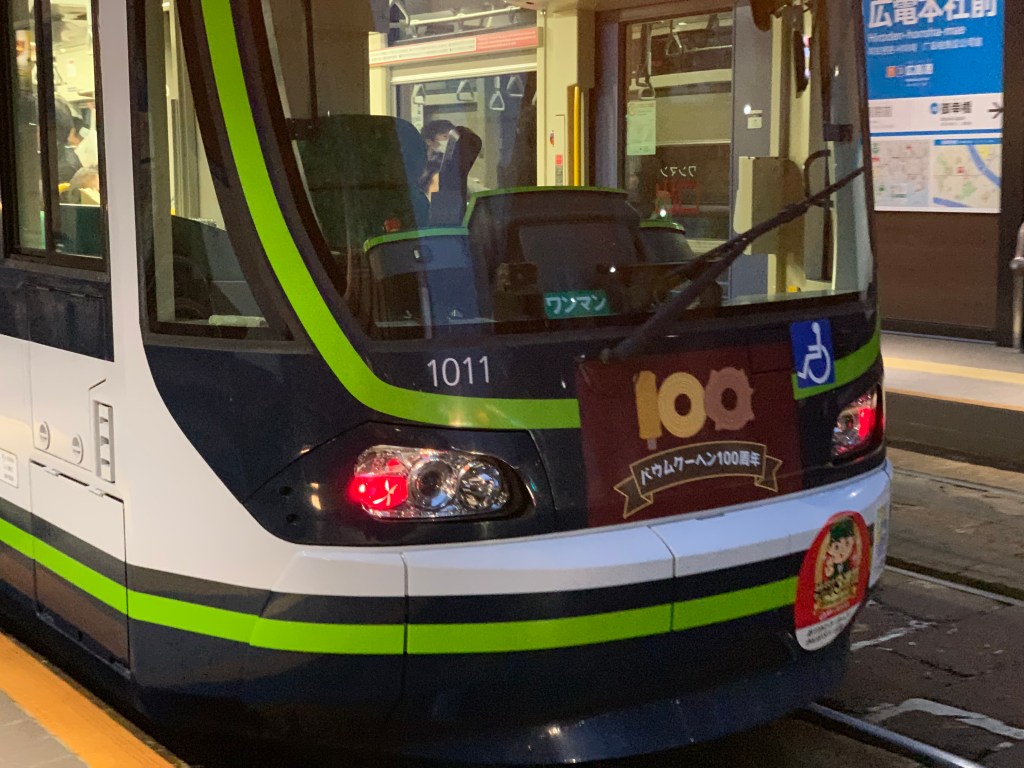
Back in 2019 in Hiroshima, quite a bit was made of the 100th anniversary of Japanese baumkuchen. One of the trams in Hiroshima even bore a special logo to commemorate the anniversary!
After the exhibition, Karl Juchheim stayed in Japan and founded the confectionery company Juchheim, and baumkuchen began to spread through department stores and Western-style confectionery shops. Its original- and continued- popularity may well come from the fact that the tree rings in the cake represent longevity, prosperity, and continuity, which makes baumkuchen an excellent fit with Japanese culture.
I came across an interestingly-named dental clinic the other day. It was called Baumkuchen Dentist, or Baumkuchen Dental Clinic.
Now, baumkuchen are very popular in Japan, but I’m not sure how big they are elsewhere, so let me explain. They’re a type of German cake (actually, in Japan, they originated in Hiroshima, but that’s another story- or another blog post).
A kind of cake. Do you see the problem here?
Yes, it’s a dental clinic named after cake!
Mind you, I suppose as far as dentists are concerned, advertising cake is probably good for business! And before anyone asks, I would absolutely go to this dentist if I lived closer! I think it’s a superb name!