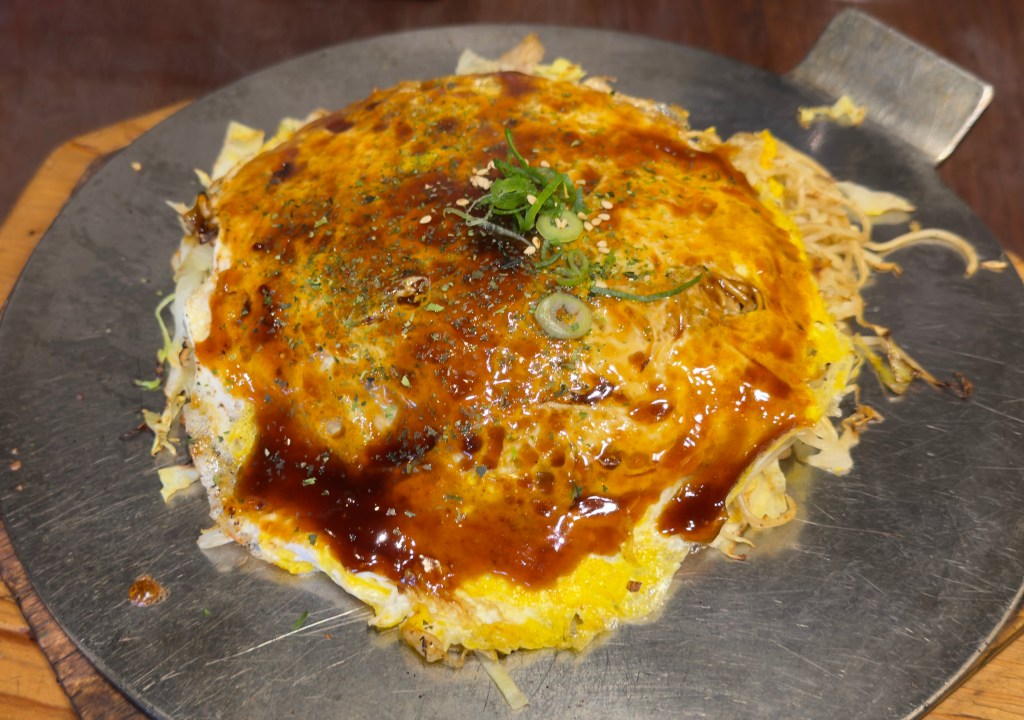
I went for okonomiyaki for lunch today, for the first time in several months. Now, of course, this being Hiroshima, okonomiyaki means Hiroshima okonomiyaki. (Hiroshima people can get quite irate if you say ‘Hiroshima-style okonomiyaki’, so I won’t, but that’s what it was.) It’s very different to Kansai okonomiyaki. This being Hiroshima, I wouldn’t dare say anything other than that I prefer the Hiroshima version to the Kansai version, but actually, that happens to be the truth.
I wrote earlier about a dentist called ‘Baumkuchen‘. So here’s a little more about baumkuchen in Hiroshima.
Baumkuchen is a traditional German cake made by layering thin coats of batter onto a rotating spit. When sliced, it resembles the rings of a tree—hence the name ‘tree cake’ (Baum=tree, Kuchen=cake).
Baumkuchen arrived in Japan- specifically, Hiroshima- thanks to Karl Juchheim, a German pastry chef.
During World War I, Juchheim was captured and held in Japan at the Bando POW Camp. After the war, in 1919, he showcased Baumkuchen at the Hiroshima Prefectural Products Exhibition. This was the first time Baumkuchen was introduced to Japan, and Hiroshima prides itself on being where it all started.
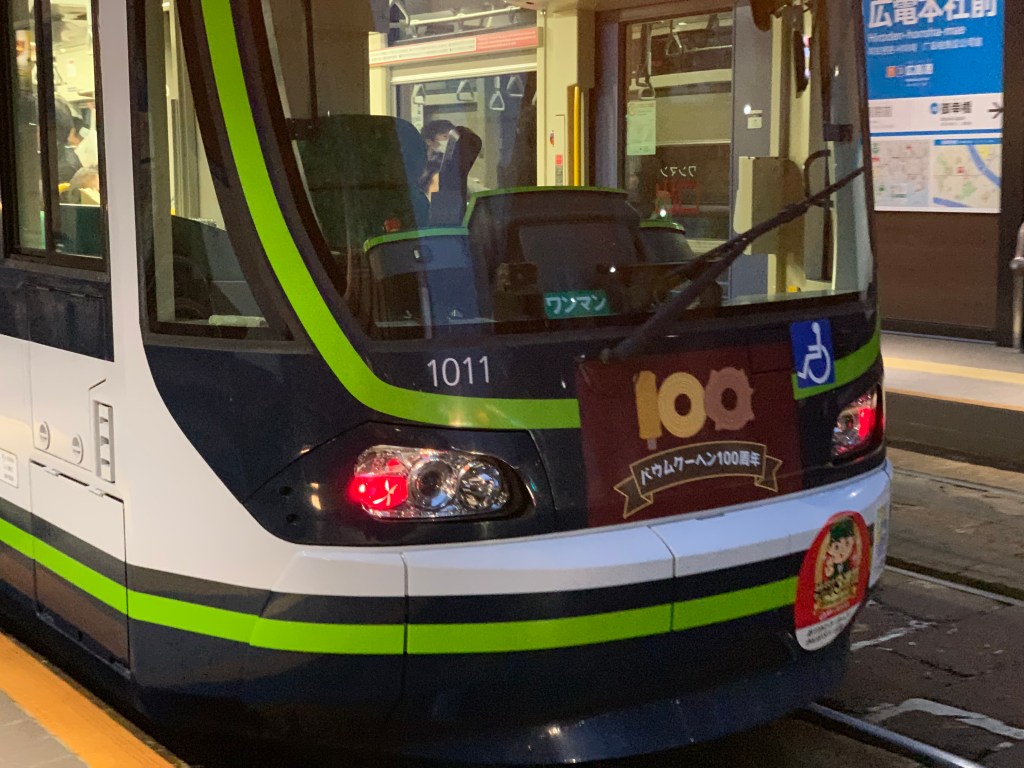
Back in 2019 in Hiroshima, quite a bit was made of the 100th anniversary of Japanese baumkuchen. One of the trams in Hiroshima even bore a special logo to commemorate the anniversary!
After the exhibition, Karl Juchheim stayed in Japan and founded the confectionery company Juchheim, and baumkuchen began to spread through department stores and Western-style confectionery shops. Its original- and continued- popularity may well come from the fact that the tree rings in the cake represent longevity, prosperity, and continuity, which makes baumkuchen an excellent fit with Japanese culture.
I came across an interestingly-named dental clinic the other day. It was called Baumkuchen Dentist, or Baumkuchen Dental Clinic.
Now, baumkuchen are very popular in Japan, but I’m not sure how big they are elsewhere, so let me explain. They’re a type of German cake (actually, in Japan, they originated in Hiroshima, but that’s another story- or another blog post).
A kind of cake. Do you see the problem here?
Yes, it’s a dental clinic named after cake!
Mind you, I suppose as far as dentists are concerned, advertising cake is probably good for business! And before anyone asks, I would absolutely go to this dentist if I lived closer! I think it’s a superb name!
Earlier today on the train, I heard two boys who looked to be of about junior high school age talking about TKG.
So what, you might ask, is TKG?
Well, it’s tamago-kake gohan, the T being tamago, K, kake, and G, gohan, which basically means ‘raw egg on rice’. It’s a Japanese dish eaten primarily for breakfast, and it is literally, as the name suggests, raw egg broken over hot rice, and quite often seasoned with soy sauce. It’s a great breakfast actually, and well worth a try if you ever get the chance. And if you get the chance to slip ‘TKG’ into a conversation while you’re in Japan, well, all the better!
Today is National Foundation Day (Kenkoku Kinen no Hi), a national holiday in Japan. It marks the founding of Japan and encourages people to reflect on the nation’s history and identity. The date of February 11 is traditionally linked to the legendary ascension of Emperor Jimmu, which is said to have occurred in 660 BC.
Anyway, for most people in Japan, the day is just a day off. And as such, outside the supermarket today, there was a blood collection drive.
Once or twice a week, I have to walk past quite a large rice field. As the year progresses, it’s always fascinating to see how the seasons change, as reflected in the rice field.
Right now, the field is bare. It’s just brown earth with a few dead stalks, presumably from last year’s rice plants, mixed into the soil. Now we’re in February, though, it won’t be too long before the farmers start to flood their fields and then plant their rice seedlings.
If you’re in Onomichi, be sure to try ice-cream from Karasawa, a shop on the street nearest to the sea. It’s hand-made, and delicious. My particular favourite is the cream zenzai: ice-cream with red beans. You may have to queue on busy days, but trust me- it’s well worth the wait.
In Japan, you can buy milk called ‘Oishii Gyunyu’. This translates to ‘delicious milk’.
And it is indeed delicious. I buy it often.
But I always wonder about one thing when I buy Oishii Gyunyu.
What’s that, you might ask?
Well, not to put too fine a point on it, why do they need to advertise it as ‘delicious’? It’s not really like any brand would say their milk was bad, is it?
If you’re in a supermarket in Japan, find the cheese section, and if you find the truffle-flavoured camembert, buy one. In fact, buy two, and send one to me, please!
Japanese camembert is always good, but this limited edition camembert has a truffle flavouring, and it’s really, really good.
Given that it’s a limited edition, there’s no telling how long it’ll be available, so better late than never. Trust me- if you like cheese, you’ll enjoy this!