
The lines in the north of Okayama and Hiroshima Prefectures are very local, but wonderful for precisely this reason. I take trips on the Geibi Line, which links Hiroshima and Niimi, in the north of Okayama Prefecture, often, but I don’t get the chance to travel along the Kishin Line, the line east from Niimi to Himeji, so often.
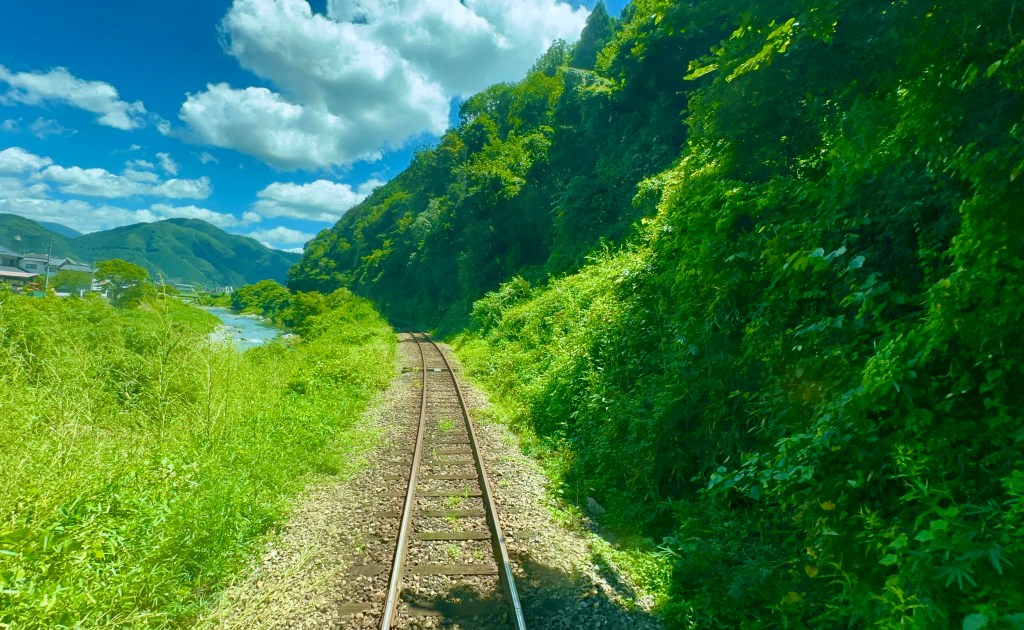
So, today I decided to take a trip along that line, albeit from Tsuyama (not Himeji) to Niimi.
By the way, many railway lines in Japan are named using kanji (characters originally from Chinese) to denote the places they link, and the Kishin line is no exception. It takes its name from the kanji 姫 (ki), from Himeji, and 新 (shin), from Niimi. And before you ask, I know that there’s no ‘ki’ sound in Himeji, nor any ‘shin’ in Niimi. To explain a difficult subject simply, most Japanese kanji have (at least!) two ways of pronouncing them: a Chinese-derived reading, and a native Japanese reading. The Chinese readings tend to be used in compound words formed of two or more kanji, as here. Used singly, 姫 is ‘hime’ and 新しい is ‘atarashii’, but in compounds, they become ‘ki’ and ‘shin’ respectively. Hence the Kishin Line.
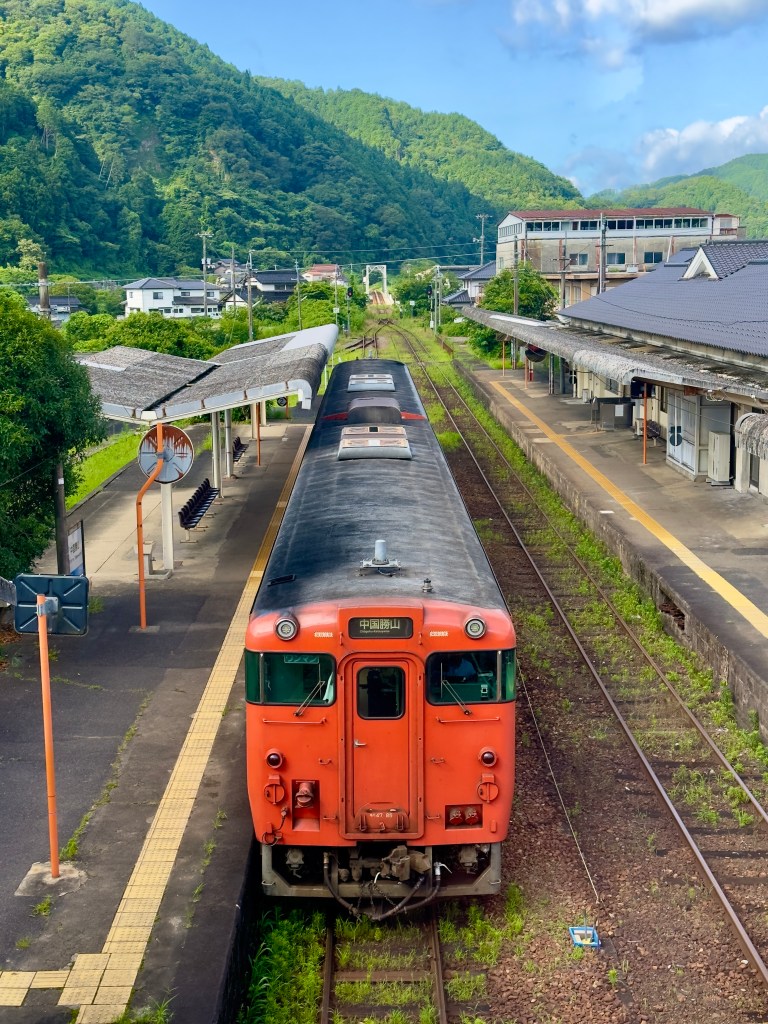
When I got to Tsuyama Station, a train for Okayama was just leaving. The line to Okayama is itself a local line, but it does have a frequent service to the prefectural capital. There’s at least a train an hour, with two an hour at some times during the day.
The other lines from Tsuyama are very different, though. The line west to Niimi, east to Himeji and north to Tottori, all have just a handful of services each day. It’s no secret that closure is very much on the cards.
In fact, one reason for my journey today was to take a trip on this line while it’s still possible. Another reason was to visit the little town of Chugoku-Katsuyama, but that’s a different story.
Anyway, the 7:11 train to Chugoku-Katsuyama left on time. On the train was the driver, me and one other man. Two carriages, and two passengers. Even for an early train on a Sunday morning, that’s not a good passenger to carriage ratio.
And nor is Tsuyama to Niimi an isolated case. In so many parts of the countryside in Japan, the local lines join places where few people live, and fewer people need to commute by train. As the train made its way towards Chugoku-Katsuyama, a trickle of passengers got on at the intermediate staions, but it was noticeable that almost all of them were high school students travelling to school. And as the birth rate decreases in Japan, it doesn’t take a genius to work out that if a line is sustained primarily by students, its long-term future isn’t bright.
As the train made its way into the countryside, an early morning mist still hung on the hills, suggesting that the day might be cloudy. But on the right side of the train, above the fields, the sky was already blue, indicating another hot summer day. We’re not out of the rainy season officially yet, but the heat and the summer clouds would seem to suggest otherwise.
A while after leaving Tsuyama, the train arrived at Mimasaka-Ochiai. The station itself was unremarkable, but I like the name. Mimasaka is the name of a region in the northern part of Okayama, but more than that, I like the name Ochiai. You see it quite often in place names and station names, especially in rural areas. It literally means ‘falling together’, but it seems to be used to indicate somewhere where routes- or in the case of railways, lines- join. It’s not a physical junction so much as a location where paths come together. To me, it invokes the old routes through the hills and fields, linking the small settlements of ancient times.
At Mimasaka-Ochiai, about 20 high school students got on, and the train started to feel a little fuller. It was interesting to see that the boys invariably went to the second carriage, while the girls came into the front carriage.
After Mimasaka-Ochiai, there were students at every station, all heading for a high school in Katsuyama, judging by the uniform. It really is no exaggeration to say that students are the lifeblood of lines like these. In fact, it’s tempting to assume that services like these, early in the morning, exist for high school students.
By now, the earlier mist had completely burnt off, and it was a beautiful summer morning. In the air conditioning of the carriage, that was. When I got off the train at Chugoku-Katsuyama Station, it was only 8:00 in the morning, but the heat was already stifling. I had three hours until the train onwards to Niimi, so I had a look around the station. Then I had a stroll into the town and wandered along the street of traditional buildings.
I got back to the station with an hour and a half until the next train. There was nothing to do, no trains to watch even. It was wonderful. I sat on a bench on the platform, and had an ice-cream. You can’t buy a ticket at Chugoku-Katsuyama Station, but you can buy an ice-cream, albeit from a vending machine. And a good ice-cream it was, too.
And after my ice-cream, I just sat and watched the clouds go by. High above the mountains the wind sent the clouds sailing by at a pretty brisk pace. However, in towns up in the hills, like Katsuyama, the surrounding mountains send the wind over and above the town itself. This means that in summer, such towns can be sweltering, with only the occasional breeze for relief. It was just like that today at Katsuyama. Still, when the breeze came it was like manna from heaven.
I like stations like Chugoku Katsuyama. They obviously used to be semi-major stations, and in a sense they still are, even if only in the context of a line that is very much minor. But at the same time, for most of the time these days they’re quiet, somnolent, undisturbed.
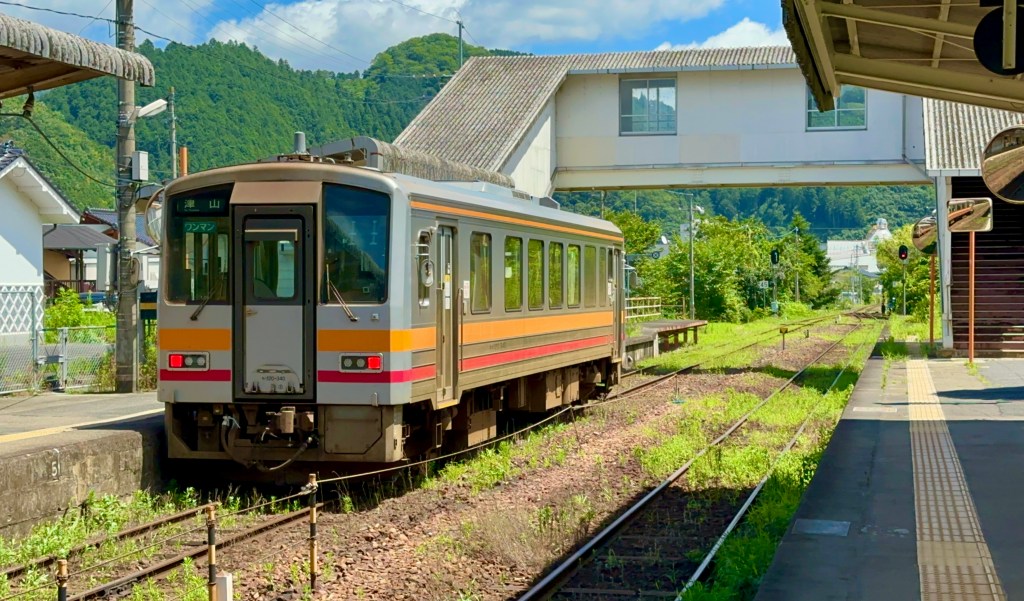
There’s something very relaxing about sitting waiting for a train for ninety minutes, with nothing to do, on a hot platform. The only movement was a trail of ants on the edge of the platform, and the clouds above. And the occasional call of a soaring kite and the metallic hum of the cicadas, still fresh for the year, were the only real sounds above the low hum of daily life. It was somehow infinitely peaceful. It made me think of the poem Adlestrop, by Edward Thomas, and especially this part, in the second stanza:
The steam hissed. Someone cleared his throat.
No one left and no one came on the bare platform.
In Katsuyama, too, no one left and no one came. No one even cleared their throat. I found myself idly reminiscing about how, as a university student, I’d hiked once out from Oxford to Adlestrop itself. I remembered the station sign board, now in the village itself, but more than anything I remembered the blister a new pair of hiking boots had given me.
Adlestrop Station is now long gone, closed back in 1966, although the railway on which it stood remains open. It’s hard to see how this railway- the Kishin Line- can remain open in the long term, unless circumstances change drastically.
Yet so much is lost when lines like this do close. Financially it might make sense, but railways, especially local railways, are about so much than economics and finances. Taking students to school, transporting and old people to hospitals and shops, bringing people from the cities back to visit families in the hometowns they left: railways are threads running through the rural communities they serve, linking them together.
So musing, I was surprised to find that it was 10:40, and the train to Tsuyama was almost due. Then, 15 minutes or so later, my train arrived, a single carriage train that was, it has to be said, surprisingly full.
The section of the line from Katsuyama to Niimi is, if anything, even more rural than the section from Tsuyama to Katsuyama. Under a sky reminiscent of high summer, the train made its way through a landscape in which as often as not, the only sign of humans was the railway itself.
At other times, though, the view opened out into a bucolic landscape of farms and fields, the flat expanse of land intersected by rivers and streams, but always surrounded by the mountains. In a way, it felt ancient. It was easy to imagine the same settlements, the same lands being farmed hundreds, or even thousands of years ago.
And all too soon, the rural landscape gave way to buildings and roads, the outskirts of Niimi, the end of the line. Niimi is a small city, and no sooner had the outskirts appeared than we were at the railway station. It had been a slow journey, over four and a half hours for a mere 72 kilometres, but with lines like the Kisuki Line, slow is part of the appeal. Not so much slow life, as slow line.
You know, it might just catch on.
 Koborebanashi
Leave a comment