
You’ve probably heard of a chocolate teapot, as in the phrase ‘as useless as a chocolate teapot’.
But what about a concrete ship? This might sound as crazy as a chocolate teapot, but in fact, concrete ships — that is, ships built out of concrete — did actually exist.
What’s more, two of them still do exist, and are recognisable as ships. They can be found in Hiroshima Prefecture, in Yasuura, Kure City. They’re called Dai-ichi Takechi Maru (第一武智丸) and Dai-ni Takechi Maru (第二武智丸), but in this article, I’ll call them Takechi Maru 1 and 2 respectively.
Anyway, a bit of history.
During World War II, Japan was short both of cargo ships and of steel that could be used for shipbuilding. It was decided that building reinforced concrete cargo ships for the Imperial Japanese Navy would be a way to save steel, and a concrete cargo ship was designed. The main design work took place in Maizuru, which even today remains a major naval base. The design was based on the E-type standard wartime design, and the concrete ships were therefore known as the EC-type standard wartime design.
(By the way, in case you’re wondering, the thickness of the concrete hull ranged from 12 centimetres above the waterline to 25 centimetres for the bottom of the ship. The bow was reinforced with steel plate to alleviate any collision damage that might occur.)
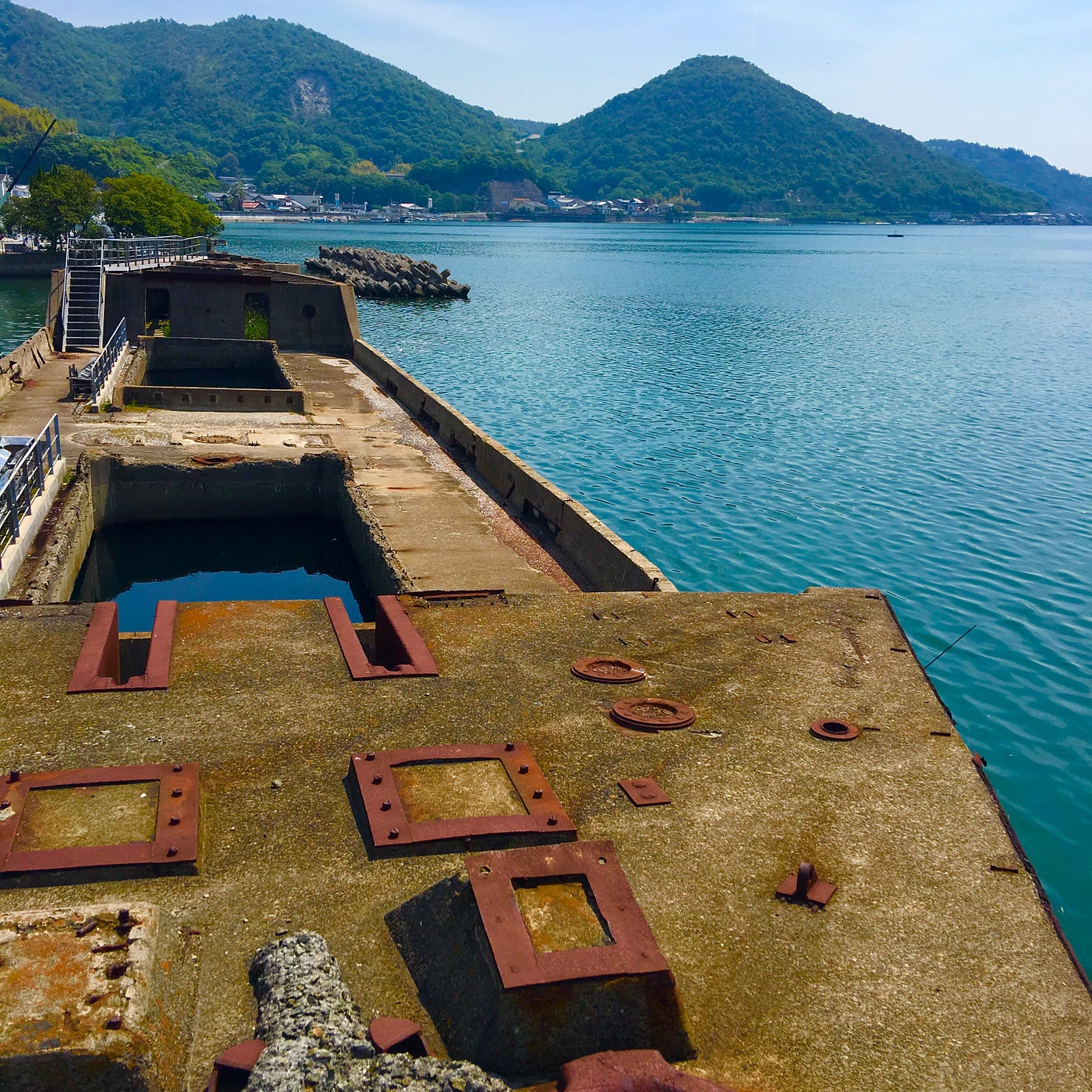
The first ship, Takechi Maru 1, was built in Hyogo Prefecture, and was completed in August 1944. Equipped with an engine, and with a sailing speed of 7 knots, it was used to transport military supplies.
After Takechi Maru 1, construction of five more ships began, but only two of the five had been commissioned by the end of the war. The fourth was at the stage of being fitted out when the war ended.
This is probably no reflection on the ships’ design or construction, but the four completed ships seem not to have been blessed with particularly good luck.
Takechi 3 struck a mine and sank off the coast of Shōdoshima (in the Inland Sea) in July, 1945, and Takechi Maru 4 was scrapped after running aground near Kōbe after a typhoon in September 1945.
Also, in May 1945, Takechi Maru 2 struck a US mine while sailing through the Kanmon Straits. However, the damage was minor, and reports state that it was not too different to what a steel-hulled ship would have sustained. So in fact, maybe the concept of concrete ships wasn’t quite so far-fetched after all.
Anyway, by just after the end of World War II, only Takechi Maru 1 and 2 remained. Takechi Maru 1 was abandoned near Kure City, but Takechi Maru 2 was still usable and was sold. However, it was soon withdrawn from service.
So, you might ask, how did two of the ships end up in a small fishing port in Hiroshima Prefecture?
Well, at the end of the war, the fishing port in Yasuura had no breakwater, and as a result, fishing boats were frequently damaged by typhoons. The Yasuura Fisheries Association petitioned Hiroshima Prefecture to construct a breakwater, but the prefecture refused, citing the huge costs of construction.
But this didn’t mean that the breakwater scheme was, well, dead in the water. Instead of constructing a whole new breakwater, the decision was made to use Takechi Maru 1, from Kure Port, and Takechi Maru 2, from Osaka Port, as the breakwater.
The ships were purchased in 1947, and foundation work began in 1949. The sterns of the two ships were connected to each other, holes were drilled in several places in the bottom of the hull, seawater was let into the ships, and they were sunk at high tide.
Actually, I suppose ‘sunk’ isn’t quite the right word, because even now, it’s possible (theoretically, at least) to stand on the deck of the ships without getting your feet wet. Perhaps it would be more accurate to say that the ships were scuppered. Anyway, once on the sea bed at the entrance to the port, they were secured by placing rubble on both sides of the hulls. The work was completed by February 1950.
Apparently, at the time of the work to install the ships as the breakwater, their superstructures were almost intact, but most of the metal structures were subsequently removed, leaving basically only the concrete hulls, and a few metal fittings embedded in the concrete.
Also, at some point in the past, the title ‘Mizu-no-mamorigami’ (水の守り神) was emblazoned on to the side of the hull of Takechi Maru 2 (the ship further from the land), proclaiming both ships to be ‘guardians of the waters’.
Anyway, this brings us to today, 80 years after the end of the war, and some 75 years after the breakwater work was completed. The two concrete ships still remain, and even now, they still act as a breakwater for Mitsuguchi Port in Yasuura. Until relatively recently, it was possible to access the ships, to walk along one side of the hulls and look down into the holds.
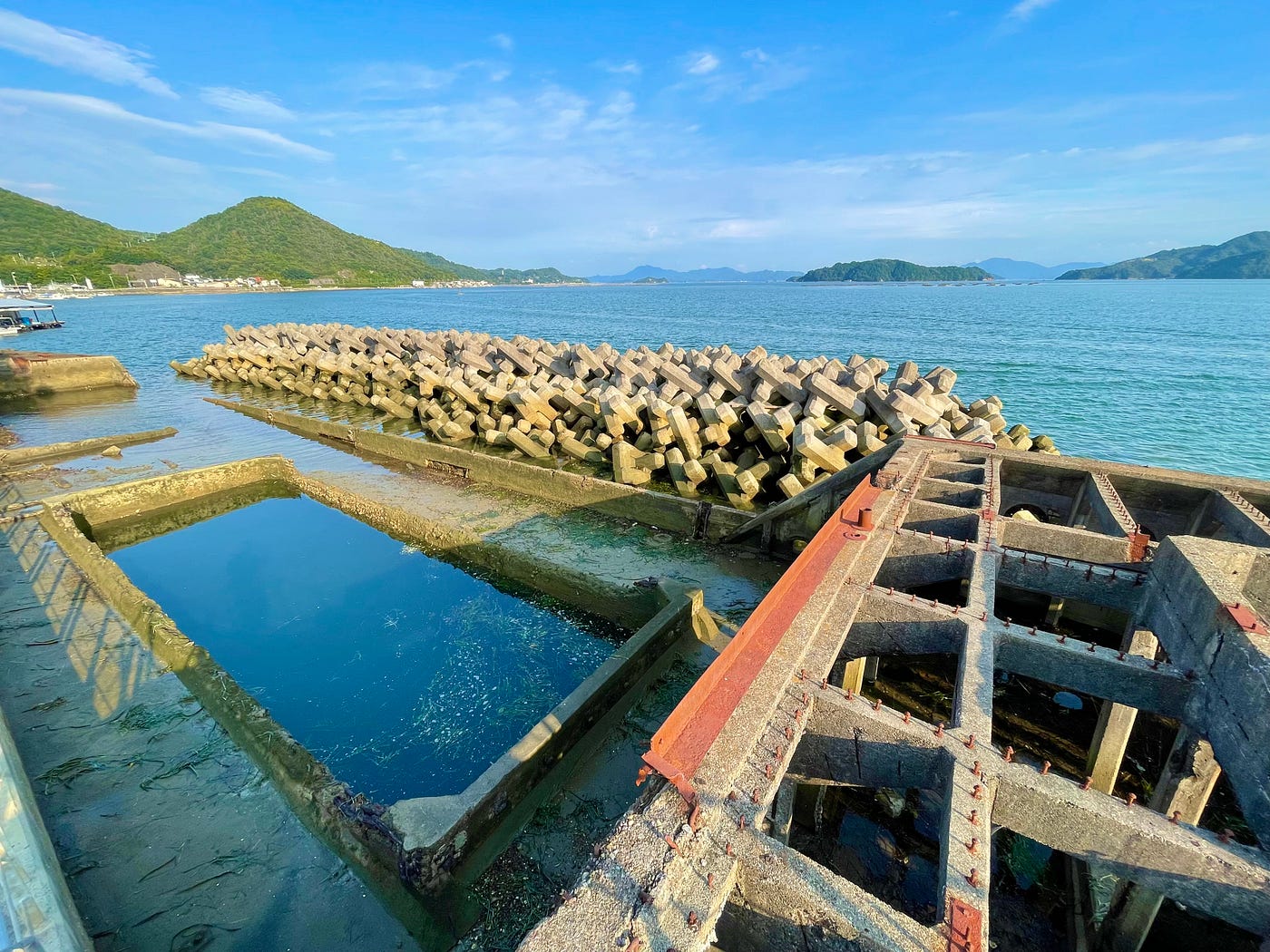
Unfortunately, the ship nearest to the land is listing quite noticeably now, and presumably because of this, the gate to access the ships is locked closed now. The ships themselves are still very visible, though: it’s about a 20-minute walk from Yasuura Station (on the JR Kure Line) to Mitsuguchi Port, from which you can get a fairly close look at them. Alternatively, from the far side of the port, you can get a more long-distance view of the two ships, and their place in the landscape. Low tide affords a better view of the ships.
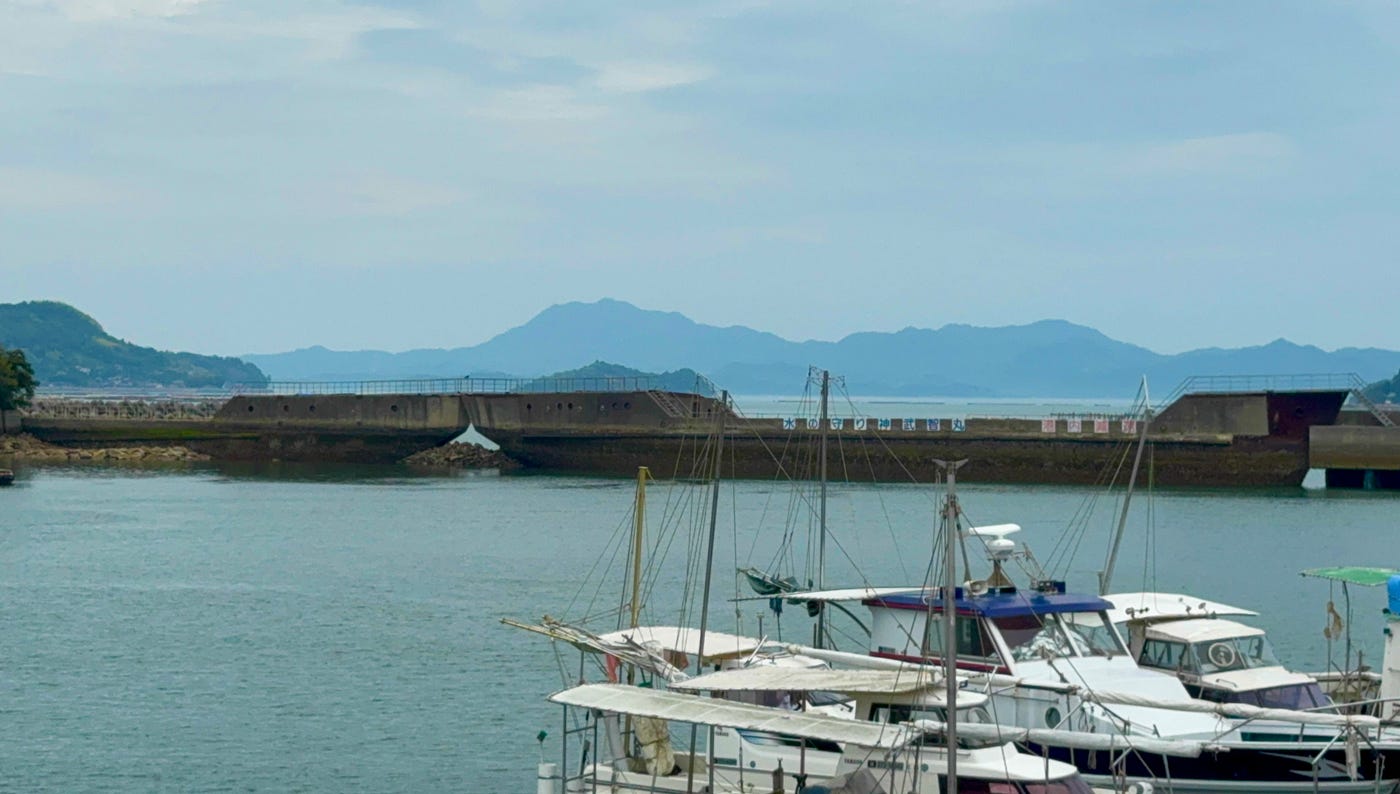
The ships Takechi Maru 1 and 2 fascinate me. Even now, when it’s no longer possible to walk out along them, I still like to visit Yasuura occasionally to gaze out at them; to think again about what they are and what they represent. I think it’s fair to say that they were certainly built out of necessity, and that they wouldn’t have come about had there not been a shortage of steel, but that by no means detracts from the fact that they were indeed built, and that they’re still in fine fettle now. Their construction, and their continued existence, are both pretty improbable, but they demonstrate that war gives rise to situations that would never happen under ordinary circumstances.
It’s amazing to think that these ships are actually physically part of World War II. Put simply, Takechi Maru 1 and 2 are very tangible, concrete- literally concrete- reminders of the history of 80 years ago. Walking on them is walking on history, in a very absolute sense. It’s wonderful that they survive, and that they act ultimately as sobering reminders of war.
But at the same time, it’s also very appropriate and quite fitting, really, that these two remnants of the war are now guardians of the waters. Not only are they tangible and meaningful reminders of war, but they also fulfil the peaceful role of protecting the fishing port in Yasuura. May they continue to do so for many years more.
 Koborebanashi
Leave a comment